

Details
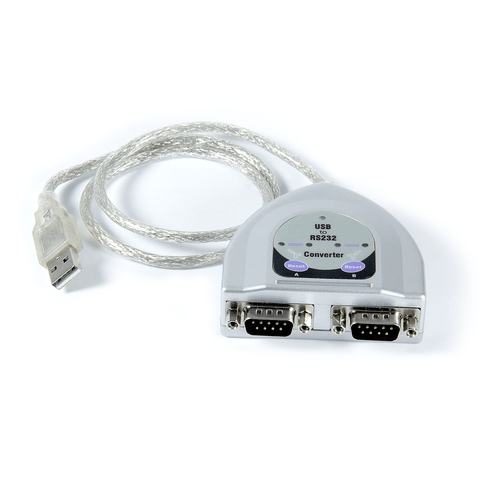
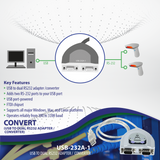
The USB-232A-1 is a port-powered, bi-directional USB to RS232 adapter / converter that can be used to convert any standard USB port (USB 2.0 - backward compatible) into two RS232C ports and vice versa. This high-quality, high-performance USB to dual RS232 adapter uses the latest FTDI chipset and is fully compatible with Windows 11 / 10 / 8 / 7 / Vista / XP / Server2008 / Server2003 / 2000 / 98 (32-bit), Windows 11 / 10 / 8 / 7 / Vista / XP / Server2008 / Server2003 (64-bit), Win CE, Mac, Linux, and Raspberry Pi. The unit comes with a USB type A male connector on the USB side and two DB9 male connectors on the RS232 side.
CommFront's products quality is ensured by our ISO-9001 quality control system (Cert No. SG12/04213, strictly certified by SGS), and we back our high-quality products with a 5-year replacement warranty and a 30-day risk-free money-back guarantee.
Features
- USB to dual RS232 adapter / converter.
- Adds two RS-232 ports to your USB port.
- 300 to 128K Baud operation (auto-sensing and self-adjusting).
- RS-232 data & signals: TX, RX, RTS, CTS, DTR, DSR, DCD, RI, and GND.
- Supports Windows 11 / 10 / 8 / 7 / Vista / XP / Server2008 / Server2003 / 2000 / 98 (32-bit), Windows 11 / 10 / 8 / 7 / Vista / XP / Server2008 / Server2003 (64-bit), Win CE, Mac, Linux, and Raspberry Pi.
- Supports remote wake-up and power management.
- Plug and play (hot-pluggable, data format auto-sensing and self-adjusting).
- Port-powered, no external power required.
- No IRQs required, no IRQ conflicts.
- Surface Mount Technology manufactured to RoHS and ISO-9001 standards.
- Safety: Strictly certified by SGS (Cert No. EM/2008/20062C, EM/2008/20063C).
- 5-year manufacturer's warranty.
Specifications
| Part Number: | USB-232A-1 |
| Compatibility: | USB 2.0 (backward compatible) and EIA/TIA RS-232C standards |
| Power Source: | Port power from USB port |
| Current Consumption: | Less than 100mA |
| Output Power on Pin 3: | About -9VDC |
| Baud Rates: | 300 to 128,000bps (auto-sensing and self-adjusting) |
| Distance: | USB side: 10ft (3m); RS-232 side: 16ft (5m) |
| Connectors: | USB side: Type A Male; RS-232 side: 2x DB-9 Male |
| LEDs: | 2x TX, 2x RX and 1x Power |
| Dimensions (H x W x D): | 0.9 x 2.8 x 3.5 in (24 x 72 x 88 mm) (excluding cable) |
| Cable Length: | 2 ft (0.6 m) |
| Weight: | 2.9 oz (83 g) |
| Operating Temperature: | 32ºF to 95ºF (0ºC to 35ºC) |
| Operating Humidity: | Up to 90% RH (no condensation) |
Downloads


Compliances
Safety

WORLD-CLASS TESTING LABS
CommFront products are strictly certified by SGS and/or TUV - the Nationally Recognized Testing Laboratories [NRTLs] in North America (approved by OSHA) and the Notified Bodies in the European Union. Learn More
Quality

DESIGNED & MANUFACTURED TO ISO STANDARDS
CommFront products are designed and manufactured to ISO 9001 standards. Our quality control system is strictly certified by SGS (Cert No. SG12/04213). Learn More
Warranty

100% SATISFACTION
CommFront products have been proven to be reliable. We back our high-quality products with a 5-year replacement warranty and a 30-day risk-free money-back guarantee. Learn More
We Also Recommend
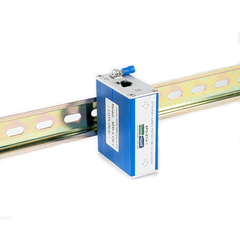
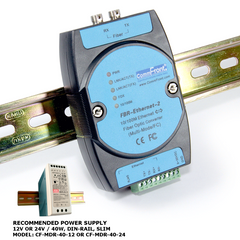
FBR-Ethernet-2 (MM/FC)
10 / 100M Ethernet to Fiber Optic Media Converter (Industrial / MultiMode / FC)
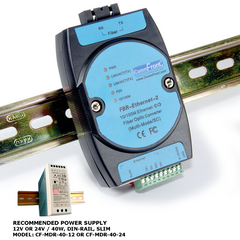
FBR-Ethernet-2 (MM/SC)