

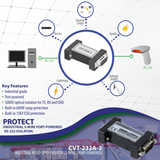
Details
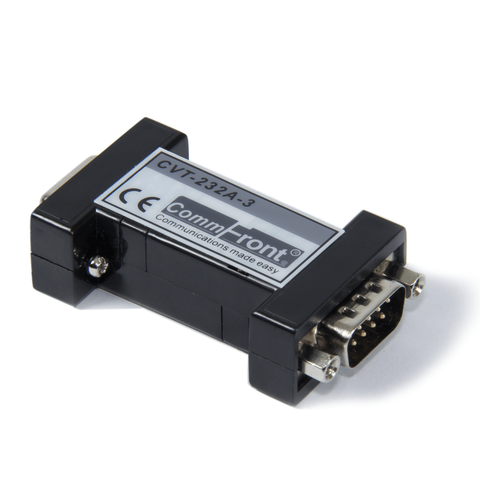
The CVT-232A-3 is a compact, rugged, industrial-grade, port-powered, 3-wire RS-232 isolator. It optically isolates three (3) RS-232 lines (TX, RX, and GND), and the 5,000V optical isolation effectively protects your RS-232 devices from ground loops, noise problems, transient surges, remote lightning, and spikes. This product operates within a temperature range of -40°F to 185°F (-40°C to 85°C) and features 600W surge protection and 15kV static protection, making it an ideal solution for harsh industrial applications. The unit is efficiently powered directly from the RS-232 data line and features auto-sensing and self-adjusting capabilities, which automatically configure baud rate, parity, stop bits, and other COM port parameters to match the connected devices. Therefore, it requires no external power supply or software drivers, making the unit a highly reliable, truly plug-and-play device.
CommFront's products quality is ensured by our ISO-9001 quality control system (Cert No. SG12/04213, strictly certified by SGS), and we back our high-quality products with a 5-year replacement warranty and a 30-day risk-free money-back guarantee.
See also: A custom-made product of CVT-232A-3 with reversed bolts and nuts (Part Number: CVT-232A(C)-3).
Features
- Rugged industrial-grade port-powered 3-wire RS232 opto-isolator.
- 5,000V optical isolation.
- Port-powered, no external power or RTS, DTR required.
- 300 to 38.4K Baud operation (auto-sensing & self-adjusting).
- Operating temperature: -40ºF to 185ºF (-40ºC to 85ºC).
- Industrial grade enclosed in a rugged, rustless ABS housing.
- Plug and play (hot-pluggable, data format auto-sensing & self-adjusting).
- No software drivers, DIP switch or jumper settings required.
- Built-in 600W surge protection, 15kV static protection and circuit protection.
- Surface Mount Technology manufactured to RoHS and ISO-9001 standards.
- CE, FCC, RoHS, and REACH certified.
- 5-year manufacturer's warranty.
Specifications
| Part Number: | CVT-232A-3 |
| Compatibility: | EIA/TIA RS-232C standard |
| Power Source: | Port power from RS232 data line |
| Current Consumption: | Less than 10mA |
| Optical Isolation: | 5,000Vrms (AC, 1 min) |
| Baud Rates: | 300 to 38,400bps (auto-sensing & self-adjusting) |
| Distance: | RS-232: 16ft (5m) |
| Connector: | DB-9 Female Connector and DB-9 Male Connector |
| Surge protection: | 600W |
| Static protection (ESD): | Up to 15KV |
| Dimensions (H x W x D): | 0.63 x 1.3 x 2.5 in (16 x 32 x 63 mm) |
| Weight: | 0.83 oz (23.5 g) |
| Operating Temperature: | -40ºF to 185ºF (-40ºC to 85ºC) |
| Operating Humidity: | 5% to 95%, non-condensing |
| Mean Time Before Failure (MTBF): | >300,000 hours @ 77°F (25°C) |
Downloads


Compliances
Safety

WORLD-CLASS TESTING LABS
CommFront products are strictly certified by SGS and/or TUV - the Nationally Recognized Testing Laboratories [NRTLs] in North America (approved by OSHA) and the Notified Bodies in the European Union. Learn More
Quality

DESIGNED & MANUFACTURED TO ISO STANDARDS
CommFront products are designed and manufactured to ISO 9001 standards. Our quality control system is strictly certified by SGS (Cert No. SG12/04213). Learn More
Warranty

100% SATISFACTION
CommFront products have been proven to be reliable. We back our high-quality products with a 5-year replacement warranty and a 30-day risk-free money-back guarantee. Learn More
We Also Recommend
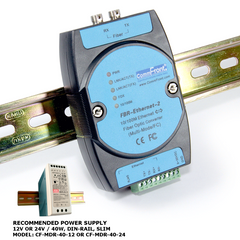
FBR-Ethernet-2 (MM/FC)
10 / 100M Ethernet to Fiber Optic Media Converter (Industrial / MultiMode / FC)
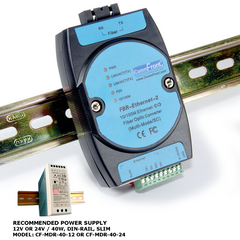
FBR-Ethernet-2 (MM/SC)